The Jazz.com Blog
June 16, 2009 · 1 comment
Hentoff on Jazz: The Healing Touch
Nat Hentoff is a regular contributor to jazz.com. His recent articles here include a discussion of efforts to nurture jazz in the schools, his account of a rare event that brought together Wynton Marsalis and Sandra Day O'Connor, and a report on the Jazz Foundation of America. Below he turns his attention to a very different type of jazz outreach program.T.G.
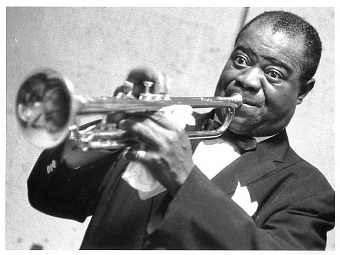
Louis Armstrong, a true believer in the healing power of music, sent recordings of jazz and classical music to a hospital in New Orleans, so they could be played for women giving birth. In keeping with his wishes, the Louis Armstrong Department of Music Therapy at New York's Beth Israel Hospital funded in part by the Louis Armstrong Foundation treats patients in pediatrics, oncology, pain care and other specialties.
Now, in a remarkably challenging venture in jazz as therapy, guitarist and vocalist Marlina Teich has founded a group called Jazzheimers to bring jazz to patients suffering from Alzheimer's disease in hospitals and other convalescent venues in San Francisco.
"They respond to music in such a different way than other people," Marlina says, "reaching them in a way that talking, medicine, psychotherapy and other forms of therapy don't. I want to honor their experience of living long lives in a society that warehouses the elderly."
"It's the music they enjoyed when their memories were intact," says Robert Sarison of the Irene Swindells Alzheimer's Residential Care Center, one of the facilities served by Marlina and Jazzheimers. "Now, even though they may not remember her, they remember the music."
"I don't do jazz that's hard to follow," adds Marlina. "The music is for the patients, so I keep it simple and easy to remember."
Every show is different, and requests are eagerly welcomed. The songs patients remember, she discovered, are from composers like the Gershwins and Cole Porter. Leading the list, Marlina told San Francisco's westernedition.com, is "As Time Goes By."
Among the listening stories she told me was about "a woman in the corner with braids and beautiful facial features, who was laughing and singing, and then would fall asleep. The start of a new song would waken her like clockwork. It was like she didn't miss a beat of the fun we were all having! She was listening and singing to the music. Practically everyone was singing that day. Another woman shouted, 'We should go on the road!' So I said, 'Sure we are. This is our rehearsal.'"
Another listener, Dorothy, joined in with spoons on a wooden chair during "On A Slow Boat to China." "She was an amasing percussionist," Marlina recalls. "I was going to follow it with a swing version of 'Autumn Leaves' so Dorothy could continue her musical prowess, but the Italian contingency of the Alzheimer's patients requested, 'That's Amore,' so since I always do requests, that's what they got.
"Two women and a man sang every damn word of the song. They sang loud and beautifully! Even woke up a few sleepers, which was ok in my book."
Every few weeks, Marlina and her musicians make the rounds of the hospitals and senior centers. At one of them, a woman was just staring off into a corner. "I thought she might be deaf," said the Jazzheimers leader. "So I went on and put the patient's hand on my guitar so she could feel the vibrations."
Toward the end of the set, the woman was smiling.
At one of Marlina's stops, there were only six patients, so she did a solo show on guitar. One of the patients, originally from London and recently diagnosed with Alzheimer's, used to go to a bomb shelter during World War II that was also an underground jazz club while the Nazis were bombing her city.
The songs Marlina played - "It Had to be You" and "Almost Like being in Love" - turned out to be songs the woman had heard underground during the war.
There's more to tell about Marlina Teich and Jazzheimers in my column next month, which will explore the scope and depth of healing by music as well as news of Marline's forthcoming CD with her own group of alto and tenor saxophonist Jules Broussard, pianist Art Khu, bassist Eugene Warren, and drummer Russ Gold. When you're in the San Francisco area, they play at the Brickhouse Caf and Bar, 426 Brannan Street, on Thursday nights.
Jazzheimers is a decidedly non-profit project. Sponsored by the Independent Arts and Media Network, the musicians get a small stipend, but there is no budget for salaries or office space. At its start in 2005, the annual budget was $3,000, and then went up to $5,000, and is now $8,000 a year. Marlina is shooting for a survival budget of $10,000 a year.
I would think that foundations, Alzheimer's research organizations, and individual donors with or without Alzheimer's patients in their families would be pleased to help support this very small but successful reawakener of memories, melodies and dreams. If you want to contribute, write to:
Jazzheimers, PMB #169, 3739 Balboa Street, San Francisco, California, 94121-2605. The message phone for Jazzheimers is 415-820-1595.
Also there must be documentary filmmakers who could help encourage others to bring the pulse and joy of jazz to Alzheimer's patients around the country.
The man who gave Jazzheimers its first grant three years was diagnosed with Alzheimer's last year, and the band plays once a month where he is a patient. "He loves to sing, Frank Sinatra style," says Marlina. "And he does two or three songs with us. He forgets fsome of the words, but he always knows hwen to come in after the solos. Also, he hasn't lost his phrasing ability or rhythm."
"He's getting increasingly ill, but still manages to come up and sing when we go there."
The music helps keep him keeping on, along with the many others energized by the life pulse of Jazzheimers.
This blog entry posted by Nat Hentoff
Tags:

Beautiful program. I hope that I age in a place where I can sing and move to music! Bless you!